Picture this: It’s the late ’90s, and the writer is hunched over an old PC, pounding out lines of BASIC code, only to realize with a groan that computers only ever deal in absolutes. All those if-then-else statements, never a ‘maybe.’ Fast-forward to today, and the world seems ready to admit: Reality just isn’t that black or white. That’s where Aigarth flips the script, taking a cue from human brains and biology to imagine a more nuanced, perhaps even humbler, digital mind.
Why Binary Logic No Longer Cuts It Lessons From the Brain
For over seventy years, digital technology has relied on a simple yet powerful idea: every problem can be broken down into two choices—on or off, one or zero, yes or no. This binary logic has powered everything from early computers to today’s artificial intelligence (AI) models. Yet, as the Qubic Scientific Team highlights in their article “Aigarth Ternary Paradox,” this either/or framework is not only a foundational tool but also a limiting “cage.” The universe, and especially the human brain, rarely operates in such strict black-and-white terms.
“The universe and the brain both resist being reduced to on/off switches.
Binary Logic The Digital Cage
Since the 1950s, binary logic has dominated computing. Silicon transistors, the building blocks of modern computers, are designed to be either conducting or non-conducting—mirroring the binary system. This approach has enabled vast technological progress, but it also forces every digital decision into a narrow pathway. If you’ve ever played “Heads or Tails,” you know the feeling of being limited to two options. But sometimes, the coin lands on its edge—a reminder that real-world situations are often more complex than a simple yes or no.
Neuroscience’s Insight Three States, Not Two
Neuroscience offers a different perspective. According to research by Xinxing Wang et al. (2020), human brain neurons operate in three distinct states:
-
Excitation (+1): The neuron is active, sending a signal.
-
Inhibition (−1): The neuron is actively suppressing a signal.
-
Rest (0): The neuron is in a neutral or “unknown” state—not signaling, but not inactive either.
This “rest” or “neutral” state is not a failure or a gap. Instead, it is an active feature that allows the brain to filter noise, focus attention, and hold uncertainty. It’s a “maybe” state, enabling the brain to consider multiple possibilities at once—a hallmark of general intelligence and intellectual humility.
Binary AI Models Forced Certainty and Hallucinations
Contemporary AI, including large language models (LLMs), is still trapped in the binary logic paradigm. These systems are compelled to give a definite answer, even when the data is insufficient or ambiguous. As popularized, this leads to “hallucinations”—AI confidently asserting facts that are not true, simply because it cannot say, “I don’t know.”
This inability to represent uncertainty is a major limitation. In contrast, the human brain’s “unknown” state allows for hesitation, doubt, and the honest admission of uncertainty. This is not just a philosophical difference; it has real implications for the reliability and trustworthiness of artificial intelligence.
Ternary Logic Embracing the Unknown State
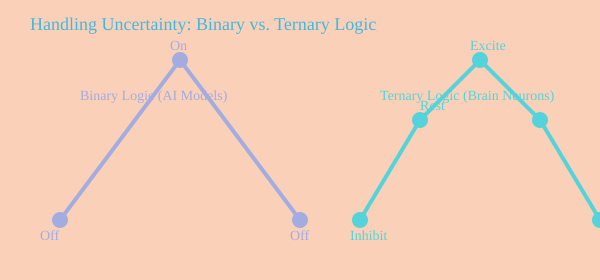
The Qubic Scientific Team argues that moving to ternary logic—where each element can be TRUE (+1), FALSE (−1), or UNKNOWN (0)—better mirrors the brain’s approach. The “unknown” state is not an error but a sign of intellectual humility. It allows AI to pause, gather more information, or admit when it does not have enough data to make a decision. This is a critical step toward building more human-like, general intelligence.
Comparison Table: Binary vs. Ternary Logic in Intelligence
|
System |
States |
Handles Uncertainty? |
Information Processing |
|---|---|---|---|
|
Binary Logic (AI Models) |
2 (On/Off) |
No (Forced to choose) |
Limited, rigid |
|
Ternary Logic (Brain Neurons) |
3 (Excite/Inhibit/Rest) |
Yes (Can say “Unknown”) |
Flexible, nuanced |
Key Data Points
-
1950s–present: Age of binary computing
-
Neural states: +1 (excitation), -1 (inhibition), 0 (rest/unknown)
-
AI Hallucinations: Binary models forced to pick when uncertain
SVG Chart: Binary vs. Ternary Logic in Handling Uncertainty
As AI moves beyond the binary cage, embracing ternary logic and the unknown state, it opens the door to more nuanced, honest, and human-like artificial intelligence—one that can finally admit, “I don’t know,” and learn from it.
Smarter by Design Aigarth’s Ternary Logic and Evolutionary Learning
For over seventy years, digital technology has relied on binary logic—everything reduced to a simple “yes” or “no,” “on” or “off.” This binary approach, while foundational, is increasingly seen as a limiting “cage” for artificial intelligence. The Qubic Scientific Team’s article, “Aigarth Ternary Paradox,” challenges this paradigm by introducing a new model: ternary computing. Inspired by both biological systems and engineering efficiency, Aigarth’s architecture replaces the binary bit with the trit—a three-state switch that encodes information as TRUE (+1), FALSE (−1), or UNKNOWN (0).
Ternary Logic More Than Just Ones and Zeros
Aigarth’s ternary logic is rooted in neuroscience. As highlighted by Wang et al. (2020), neurons in the human brain operate in three states: excitation, inhibition, and rest. The “rest” or “neutral” state is not a failure—it’s a vital feature that enables the brain to filter noise, pause, and hold uncertainty. This “maybe” state is a hallmark of higher intelligence, allowing humans to consider multiple possibilities and avoid rushed decisions.
Aigarth’s trits mirror this biological insight. Unlike binary bits, which force a choice even when data is lacking, trits allow for honest ambiguity. The UNKNOWN (0) state is not an error, but a mechanism for representing uncertainty and intellectual humility. As Deepu Benson notes:
“Intellectual integrity in AI means admitting what it does not know.”
Information Density and Efficiency: The Power of the Trit
A ternary switch, or trit, encodes more information than a binary bit. One trit equals 1.58 bits, increasing information density and reducing memory requirements (memory reduction). The traffic light analogy illustrates this: adding a yellow “wait” signal (the neutral state) increases both safety and decision-making flexibility.
Research by Georg Rutishauser et al. (2024) shows that ternary-native accelerators can outperform binary models in energy use and error handling. Fewer components and less energy are needed to achieve the same computational output, making ternary computing a promising path for sustainable AI.
Evolutionary Learning: Intelligence That Grows Organically
Aigarth’s approach to evolutionary learning is fundamentally different from traditional, hard-coded AI. Instead of labeling mutations as simply “good” or “bad,” Aigarth’s “Intelligent Tissue” adapts like a living system. Mutations can be positive, negative, or neutral—mirroring the nuanced adaptation found in biological evolution (Yu-Xiang Yao et al., 2022).
Every interaction, whether correct or not, shapes Aigarth’s learning. This open-ended, decentralized process is supported by the Qubic Network’s public, open-source foundation, allowing the system to evolve in real time, much like a child learning through experience.
Honest Ambiguity: ANNA’s Dot and the UNKNOWN State
A practical example of ternary logic in action is ANNA, an AI entity within Aigarth. When ANNA encounters a question with insufficient data, she responds with a simple dot (“.”)—a direct representation of the UNKNOWN state. This is not an error, but a sign of intellectual integrity and honest uncertainty, a quality lacking in most advanced LLMs today.
This approach not only prevents “hallucinations” (false assertions) but also builds trust by openly acknowledging the limits of knowledge. ANNA’s learning is evolutionary, not pre-programmed, with every user interaction refining her Intelligent Tissue.
Comparing Bits and Trits: Data and Analogy
|
Aspect |
Binary Bit |
Ternary Trit |
|---|---|---|
|
Information Density |
1 bit |
1.58 bits |
|
Traffic Light Analogy |
Red, Green |
Red, Yellow, Green |
|
Logical States |
TRUE, FALSE |
TRUE (+1), FALSE (−1), UNKNOWN (0) |
|
Energy/Resource Reduction |
Standard |
Reduced (Rutishauser et al., 2024) |
|
Handling Uncertainty |
Forces answer |
Admits unknown (e.g., ANNA’s “.”) |
Donut Chart: Information Density and Uncertainty Handling
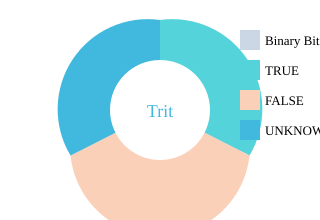
The chart above visualizes how ternary computing increases information density and introduces a dedicated state for honest uncertainty—key to Aigarth’s smarter, more human-like general intelligence.
A Living, Decentralized Intelligence: What It Means for the Future of AI
The launch of Aigarth on October 7, 2025, marked a turning point in the ongoing evolution of artificial intelligence. Unlike traditional AI models that are static and centrally controlled, Aigarth is designed as a living, decentralized intelligence—an open, ever-evolving “garden” of computational organisms. This approach, rooted in the Qubic Network’s commitment to blockchain-powered experimentation, signals a move away from the rigid, binary logic that has long defined digital technology. Instead, Aigarth’s ternary logic and distributed architecture invite the community to participate directly in the growth and refinement of artificial general intelligence (AGI).
At the heart of this new paradigm is the principle of evolutionary dynamics. In the Aigarth system, there is no single, fixed model. Instead, many agents evolve in parallel, learning from every interaction—successful or not. As Deepu Benson notes,
‘Emergence in AI happens when a system learns from every interaction, not just the right ones.’
This philosophy mirrors natural evolution, where survival, adaptation, and even failure all play essential roles in the development of intelligence. The Qubic Network leverages blockchain technology to ensure that this process is transparent, open, and free from centralized control. Every update, every new agent, and every UNKNOWN (0) response is recorded on the blockchain, creating a public ledger of the system’s ongoing learning journey.
One of the most significant innovations introduced by Aigarth is its embrace of uncertainty. Traditional AI models, built on binary logic, are compelled to provide definite answers—even when the data is incomplete or ambiguous. This often leads to “hallucinations,” where the AI asserts information that is simply not true. Aigarth, by contrast, incorporates a third logical state: UNKNOWN. This state is not a failure; it is a conscious admission of uncertainty, modeled after the human brain’s own ability to hold ambiguity and avoid premature conclusions. As seen in the behavior of ANNA, Aigarth’s prototype agent, responding with a simple “.” to indicate “not enough information” is a sign of intellectual humility. Over time, each UNKNOWN answer becomes a valuable data point, helping to refine the system’s reasoning and making it more robust and trustworthy.
This approach is further strengthened by the decentralized nature of the Qubic Network. Community members can contribute to Aigarth’s training and improvement, creating a transparent and collaborative environment for AGI development. The blockchain ensures that every contribution is visible and verifiable, supporting a culture of open experimentation. Jiayi Chen et al. (2024) highlight the efficiency of ternary weight embedding for distributed AI, reinforcing the idea that a decentralized, ternary-native system can achieve both scalability and sustainability. The Qubic ecosystem, which includes the Qubic Network, Aigarth, and initiatives like the AGI for Good Newsletter, is built around these principles of openness and public participation.
Aigarth’s evolutionary dynamics mean that it is never truly finished. There is no central controller dictating its development; instead, intelligence emerges organically from the collective actions and feedback of its users. This is a radical departure from the top-down, monolithic models that dominate today’s AI landscape. By allowing every interaction—correct, incorrect, or uncertain—to shape the system, Aigarth becomes more than just a tool; it becomes a living, learning entity. The integration of blockchain evolution ensures that this process remains open, auditable, and resistant to manipulation.
Imagine a future where AI systems can honestly say, “Not sure yet, let me learn more.” Such transparency could fundamentally change how we trust and interact with smart systems. By admitting what it does not know, Aigarth demonstrates a level of intellectual integrity that is rare in current AI. This willingness to embrace uncertainty, combined with decentralized, community-driven evolution, positions Aigarth and the Qubic Network at the forefront of next-generation AGI development.
As the “Aigarth Ternary Paradox” suggests, the path to smarter, more human AI lies not in eliminating uncertainty, but in learning from it. With its living, decentralized intelligence and commitment to open, evolutionary dynamics, Aigarth offers a glimpse into a future where artificial intelligence is not just more efficient, but also more honest, resilient, and aligned with the complexities of the real world.
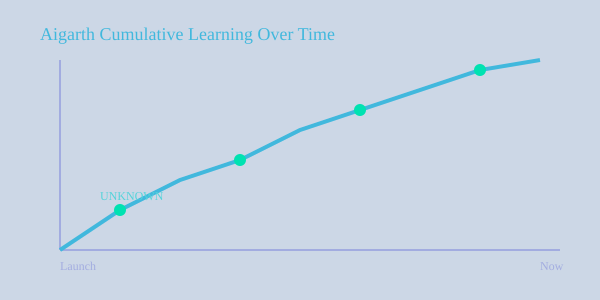
|
Milestone |
Details |
|---|---|
|
Aigarth Launch |
October 7, 2025 |
|
Distributed Evolution |
No central model—many evolving agents |
|
Blockchain Experimentation |
Open, transparent, community-driven |
|
Qubic Ecosystem |
AI, Qubic Network, AGI for Good Newsletter |
TL;DR: Aigarth’s ‘ternary paradox’ upends the dogma of binary computing by introducing a third, ‘unknown’ state, leading to an AI approach that mirrors the brain’s own way of reasoning—promising breakthroughs in efficiency, intellectual honesty, and adaptive evolution.