There’s something strangely energizing about talking AI over morning coffee—maybe it’s the thrill of futuristic possibility, maybe it’s just the caffeine. In June 2024, headlines are still dominated by stories of chatbots that write novels, robots in medicine, and debates over machines ‘stealing’ jobs. But is the hype deserved? Before we hand over our passwords to a friendly robot—or panic about our professional obsolescence—let’s take a look at the unvarnished reality beneath the sensationalism, with a few stories (and statistics) you might not expect.
From Turing’s Dream to TikTok: The Wanderings of Artificial Intelligence
Artificial Intelligence (AI) has come a long way since Alan Turing’s famous question: “Can machines think?” Back in the 1950s, Turing and his peers debated the future of thinking machines over tea and soggy biscuits, laying the foundation for what would become a multi-billion-dollar industry. Turing’s Turing Test (1950) set the stage: if a machine could convincingly imitate human conversation, could it be considered intelligent? This question still echoes through today’s AI-powered apps, from TikTok’s recommendation engine to ChatGPT’s conversational prowess.
Early AI was quirky and ambitious. The first computers could only follow strict rules—think of them as diligent but unimaginative clerks. As programming evolved, so did the dream: could machines learn like humans? Enter Machine Learning, where algorithms move beyond rigid instructions and start to recognize patterns, adapt, and even surprise their creators (sometimes after a few too many coffee breaks).
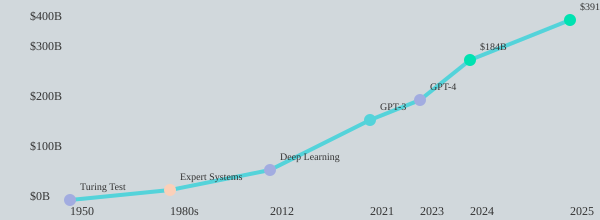
The 1980s saw a boom in rule-based “expert systems,” but progress was uneven. AI’s journey has been anything but linear, with “AI winters” (periods of stagnation) followed by bursts of innovation. The real breakthrough came in 2012, when Deep Learning—a technique using multi-layered neural networks—smashed records in image recognition (ImageNet). Suddenly, AI could see, hear, and even talk with uncanny accuracy.
By the 2020s, Large Language Models (LLMs) like GPT-3, GPT-4, Gemini, and Claude pushed boundaries further, generating human-like text and powering everything from search engines to creative writing tools. Yet, even these powerful systems can trip over basic logic—like figuring out who’s on first in an Abbott and Costello routine—reminding us that true understanding remains elusive.
AI’s impact is now everywhere: in classrooms, offices, hospitals, and social feeds. An (invented) 1990s classroom anecdote: a teacher, eyeing a student’s calculator, wonders if it’s “magic” or “cheating”—a suspicion that echoes today as educators grapple with AI-generated essays and homework.
“We can only see a short distance ahead, but we can see plenty there that needs to be done.” – Alan Turing
Timeline of Major AI Innovations
| Year | Innovation |
|---|---|
| 1950 | Turing Test concept introduced |
| 1980s | Rise of rule-based expert systems |
| 2012 | Deep learning resurgence (ImageNet) |
| 2021 | Release of GPT-3 |
| 2023 | OpenAI launches GPT-4 |
| 2024 | AI market reaches $184B |
| 2025 | AI market projected at $391B (28.46% annual growth) |
AI Market Growth: 1950s–2025
Neural Nets, LLMs, and Autonomous Pizza: What AI Really Is (and Isn’t)
Artificial Intelligence (AI) is everywhere in 2024, but what’s really happening inside the “black box” of Generative AI, Large Language Models, and Deep Learning? Despite the hype, AI is less like a sci-fi movie and more like a very persistent, sometimes clumsy, digital intern. Neural networks—the backbone of modern AI—mimic how humans learn by adjusting internal “weights” as they process data. But as one AI engineer put it:
“A neural network is like a hungry toddler: it’ll sample everything it can reach, but that doesn’t mean it understands the dinner menu.”
Ask a neural net what pizza tastes like, and you’ll get data, not drool. This gap between pattern recognition and true understanding is at the heart of today’s AI trends.
Machine Learning, Deep Learning, and Reinforcement Learning—Explained
- Machine Learning (ML): Algorithms learn from data to spot fraud, recognize faces, or recommend movies. Supervised ML uses labeled data (“this is a cat”), while unsupervised ML finds patterns in unlabeled data (“these customers shop alike”).
- Deep Learning (DL): A subset of ML using multi-layered neural networks. Deep Learning powers image recognition, speech-to-text, and even self-driving cars—think of it as ML with extra layers (and extra messes, like a toddler with crayons).
- Reinforcement Learning (RL): Systems learn by trial and error, maximizing rewards—like a robot learning to deliver pizza without bumping into walls.
Large Language Models: ChatGPT, Gemini, Claude, and the Art of Confident Guesswork
LLMs such as GPT-4, Gemini, and Claude dominate natural language applications in 2024. Trained on massive datasets, they write, translate, summarize, and sometimes “hallucinate” facts with unsettling confidence. While LLMs excel at mimicking human language, they don’t truly understand logic or meaning—they’re skilled at pattern prediction, not comprehension.
Not All AI Is Created Equal: ANI, AGI, and ASI
Most real-world AI is Artificial Narrow Intelligence (ANI): think Siri, Alexa, ChatGPT, or image recognition—specialists, not generalists. Artificial General Intelligence (AGI)—the adaptable, human-level AI of science fiction—remains theoretical. And Artificial Superintelligence (ASI), the “Skynet” of AI debates, is still a hypothetical concept, though it sparks lively discussions about existential risks.
| Type | Capabilities | Examples | Status (2024) |
|---|---|---|---|
| ANI | Task-specific, narrow focus | Siri, Alexa, ChatGPT, Tesla Autopilot | Deployed |
| AGI | Human-level adaptability, reasoning | Jarvis (fictional), GPT-5 (in development) | Theoretical/Developing |
| ASI | Superhuman intelligence, self-improving | Skynet (fictional), Roko’s Basilisk (thought experiment) | Hypothetical |
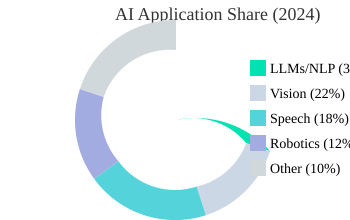
AI Application Share in 2024
In summary, neural networks, LLMs, and deep learning drive today’s AI—from chatbots that sometimes “hallucinate” to autonomous vehicles navigating city streets. But while the technology is powerful, it’s still learning—sometimes with the messy curiosity of a toddler and the confidence of a chatbot that just accidentally insulted your mom.
AI in the Wild: From Smart Vacuums to Hospital Wards and Beyond
Artificial intelligence is no longer a distant promise—it’s a daily reality, quietly reshaping everything from household chores to hospital care, classrooms, and city streets. As AI adoption surges, the technology’s reach is both practical and, at times, unexpectedly quirky.
Home Front: Smart Devices with Personality
AI has made itself at home, quite literally. Today’s smart vacuums not only map your living room but also offer friendly status updates, while voice assistants like Alexa, Google Assistant, and Siri manage schedules, play music, and even tell jokes. Smart fridges track groceries and suggest recipes, sometimes with amusing results (“Did you mean to buy twelve heads of lettuce?”). Biometrics—like Face ID—secure devices, while chatbots and wearables personalize user experiences, making AI a quiet but constant presence in daily life.
Healthcare’s AI Surge: From Breakthroughs to Bedside Robots
AI in healthcare is experiencing rapid growth, with 223 FDA-approved AI-enabled medical devices in 2023 alone. These tools power diagnostic breakthroughs—such as DeepMind’s AlphaFold for protein folding and AI-driven cancer detection—while also introducing new dynamics to patient care. As Dr. Fei-Fei Li notes,
“AI isn’t just transforming medicine; it’s rewriting the script on what doctors and patients can expect.”
Yet, not every AI moment is seamless; some hospitals have reported awkward interactions with bedside robots or AI-powered assistants that still struggle with nuanced patient needs. Nonetheless, the sector’s rapid AI adoption is undeniable.
Education’s Digital Classroom: Algorithms at the Blackboard
AI in education is booming, with the market size reaching $7.57 billion in 2025 and projected to soar to $112.30 billion by 2034. Adaptive learning platforms tailor lessons to individual students, while chatbots answer homework questions (though a calculus chatbot may still fumble when grading creative doodles). The promise: more personalized, accessible learning. The reality: mixed results, with ongoing debates about AI’s role in assessment and engagement.
Workplace Realities: Automation, Assistance, and Awkward Zooms
AI-powered productivity tools like Microsoft Copilot and GitHub Copilot are changing how people work, automating routine tasks and offering coding suggestions. OpenAI APIs and Amazon Bedrock provide enterprise-level solutions, making some jobs easier—and others harder to explain in meetings. The impact on employment is complex: AI streamlines workflows but also raises questions about job displacement and the evolving nature of work.
Autonomous Vehicles: The Self-Driving Revolution
Autonomous vehicles are moving from science fiction to city streets. Waymo now provides over 150,000 weekly self-driving rides, while Baidu’s Apollo Go operates in multiple Chinese cities. Picture a ride in a self-driving taxi that reroutes for construction and politely asks for your playlist—AI is not just driving, but engaging.
Beyond Talk: Recognition, Translation, and Biometric Wonders
AI powers image and video recognition (Clarifai, Amazon Rekognition), real-time language translation (Google, Microsoft, Amazon), and biometric identification. These tools offer convenience and security, but also spark debates about privacy and data use.
| Industry | Key AI Applications | Major Companies | 2023–2025 Data |
|---|---|---|---|
| Healthcare | Diagnostics, Drug Discovery | DeepMind, IBM, GE | 223 FDA AI devices (2023) |
| Education | Adaptive Learning, Chatbots | Duolingo, Pearson, Coursera | $7.57B (2025), $112.30B (2034) |
| Autonomous Vehicles | Self-Driving Cars, Taxis | Tesla, Waymo, Baidu | 150k+ weekly rides (Waymo, 2024) |
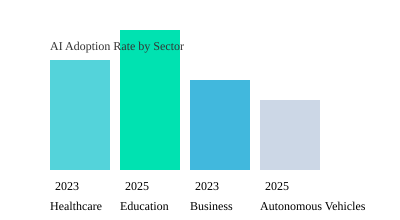
| Business | Productivity, Coding Assistants | Microsoft, OpenAI, Amazon | AI Adoption: 55% (2023), 77% (2025) |
Power Players, Big Bets: Who’s Shaping the AI Race Today?
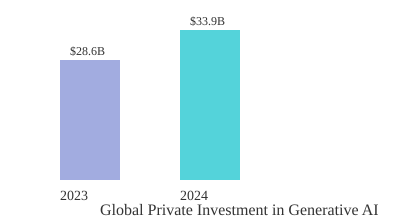
Artificial intelligence is no longer the exclusive domain of Silicon Valley. Today’s AI market growth is a global phenomenon, with innovators and investors spanning continents—from London’s DeepMind to Beijing’s Baidu. The race to lead in Generative AI, machine learning, and automation is marked by fierce competition, bold partnerships, and a steady surge in private investment. In 2024 alone, global private investment in Generative AI reached $33.9 billion, up 18.7% from 2023, reflecting both rising AI adoption and the relentless pace of innovation.
Profiles in Ambition: The Movers and Shakers
The current AI landscape is defined by a handful of industry leaders and their flagship products:
- DeepMind (London): Known for AlphaFold, which revolutionized protein structure prediction, DeepMind continues to push the boundaries of scientific AI. As CEO Demis Hassabis notes,
“Competition in AI isn’t about who builds the smartest machine; it’s about who asks the boldest questions.”
- OpenAI (San Francisco): The force behind ChatGPT, GPT-4, and Dall-E, OpenAI’s Generative AI models have set new standards for language and image generation, sparking fresh AI trends across industries.
- Anthropic (San Francisco): With Claude, Anthropic is focused on building safer, more reliable large language models, emphasizing transparency and ethical AI development.
- Microsoft (Redmond): Through Copilot for Microsoft 365 and deep Azure AI integrations, Microsoft is embedding AI into productivity tools used by millions, accelerating global AI adoption.
- Apple (Cupertino): Apple’s AI-enhanced devices, from iPads to Siri, focus on privacy and seamless user experience.
- Amazon (Seattle): Amazon Bedrock and AWS AI services provide scalable solutions for enterprises, while Alexa continues to lead in smart home AI.
- Baidu and Alibaba (Beijing): These tech giants are driving AI trends in Asia, from language models to autonomous vehicles.
- Tesla, Cruise, Lenovo: Leaders in autonomous driving, robotics, and AI-powered devices, expanding the ecosystem beyond software into hardware and mobility.
Ecosystem in Flux: Partnerships, Integrations, and “Brand Wars”
The AI ecosystem is in constant motion. Strategic alliances—like Microsoft’s partnership with OpenAI and Amazon’s cloud integrations—are reshaping the competitive landscape. At major tech expos, “brand wars” play out not just in product launches, but in NDA-fueled meetings, exclusive swag bags, and the subtle drama of industry insiders chasing the next big thing. These human elements underscore that behind every breakthrough, there’s a race for talent, attention, and influence.
Key AI Companies, Flagship Products, and Major Launches (2023–2025)
| Company | Flagship Product | Notable Launch (Year) |
|---|---|---|
| OpenAI | GPT-4, Dall-E | GPT-4 (2023) |
| DeepMind | AlphaFold | AlphaFold (2023) |
| Anthropic | Claude | Claude (2024) |
| Microsoft | Copilot | Copilot for 365 (2024) |
| Amazon | Bedrock | Bedrock (2024) |
| Baidu | ERNIE Bot | ERNIE Bot (2023) |
Global Private Investment in Generative AI (2023 vs. 2024)
As the AI market continues to expand, these power players and their bold bets are setting the pace for global AI trends, shaping how technology is adopted and integrated across every sector.
Grey Areas and Fault Lines: Uncomfortable Questions About AI Ethics, Privacy, and Work
AI’s rapid expansion has brought not just innovation, but also a host of ethical, privacy, and employment dilemmas. As Kate Crawford notes,
“Technology is never neutral: it reflects the values—and anxieties—of its time.”
In 2024, these anxieties are front and center, with 60% of the world’s population now covered by AI-related regulations. Below, we untangle the messiest debates shaping the future of AI Ethics, AI Privacy, AI Security, Generative AI, and the AI Employment Impact.
Surveillance, Deepfakes, and the Ethics of “Personalization”
AI’s ability to analyze faces, voices, and behaviors blurs the line between helpful personalization and intrusive surveillance. Widespread use of facial recognition and data scraping has sparked global privacy debates. For example, biometric systems in public spaces promise security but raise questions about consent and data misuse. In 2024, legal frameworks in the EU, China, and California have attempted to address these concerns, but enforcement and transparency remain uneven.
Copyright, Creators, and Courtrooms
Generative AI models, trained on vast internet-scraped datasets, have triggered a wave of copyright lawsuits. In 2024, artists and publishers challenged leading AI companies over unauthorized use of creative works. Courts in the US and EU are now grappling with whether AI-generated content infringes on original creators’ rights—a legal headache that’s far from resolved.
Misinformation and Cybersecurity: AI as Both Shield and Sword
AI’s power to generate deepfakes and synthetic media has fueled a new era of misinformation. During a recent tech conference, a deepfake video played during a panel, prompting a scramble to “fact-check” reality in real time—a vivid reminder of AI’s double-edged nature. At the same time, AI-driven cybersecurity tools are critical in defending against sophisticated attacks, making AI both a risk and a remedy in digital information wars.
The Job Paradox: Displacement and Reinvention
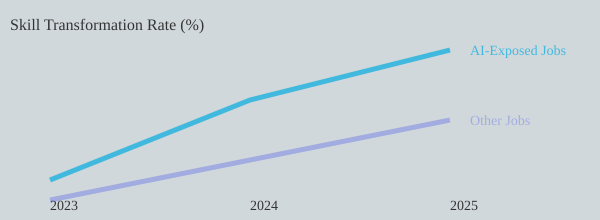
The AI Employment Impact is complex: by 2025, 85 million jobs are expected to be displaced, but 97 million new roles will be created, according to the World Economic Forum. Roles exposed to AI are seeing skills requirements change 66% faster than others, forcing workers and employers to adapt rapidly. While automation erases some tasks, it also creates opportunities in AI oversight, prompt engineering, and digital ethics.
| AI Ethical Concern | Key Regulation/Law | Coverage | Year |
|---|---|---|---|
| Facial Recognition & Privacy | EU AI Act, China PIPL, California CCPA | 60% of global population | 2024–2025 |
| Copyright & Data Use | US Copyright Cases, EU Copyright Directive | US, EU | 2023–2024 |
| AI in Healthcare | FDA AI Device Approvals | 223 devices (US) | 2023 |
| Employment Impact | OECD AI Principles, National AI Strategies | Global | 2024–2025 |
AI Ethics
AI Privacy
AI Security
AI Employment Impact
Copyright & Misinformation
How to Ride the AI Rollercoaster: Advice, Tangents, and a Few Cautions for 2025
Artificial intelligence is not just a buzzword—it’s a fast-moving train reshaping how people work, learn, and live. As AI adoption accelerates, so does the demand for new skills. According to recent workforce data, AI-exposed jobs are seeing skill requirements change 66% faster than other roles between 2023 and 2025. This rapid transformation means that a ‘growth mindset’ is no longer optional—it’s essential for anyone navigating today’s job market.
AI Skills Demand: Why a Growth Mindset Matters
AI trends show that roles involving AI—from customer service to software development—are evolving at record speed. Workers in these positions must adapt quickly, learning to leverage tools like Microsoft Copilot, ChatGPT, and industry-specific AI platforms. Upskilling is now a continuous process, with a wide variety of resources available, including tech guides, how-to articles, and global newsletters such as Tech Today.
Anecdote: The Small Business Owner’s AI Journey
Consider the story of a small business owner who initially met AI with skepticism. She dismissed chatbots and automation as “gimmicks”—until a competitor’s AI-powered marketing campaign doubled their sales. Her eventual ‘aha moment’ came after experimenting with AI-driven inventory tools, but she now regrets not upskilling sooner. Her advice: “Don’t wait for the AI wave to pass you by—ride it, or risk being left behind.”
Resources for Grappling with Change
- Tech Guides & How-Tos: Step-by-step articles for mastering new AI tools.
- Newsletters: Regular updates from ZDNET and Tech Today keep users informed on AI employment impact and trends.
- Global Editions: Access resources in local languages via ZDNET France, Germany, Korea, Japan.
- Community Stories: Learn from real-world anecdotes and case studies shared by ordinary users.
Wild Card: Would You Trust AI with Your Pet?
Imagine it’s October 2025. Your AI assistant not only schedules your meetings but also outsources your pet’s vet visits and customizes its treat routine based on health data. Would you trust it? This scenario highlights both the promise and unpredictability of AI adoption—reminding users to stay curious, proactive, and never outsource common sense.
| Year | AI-Exposed Jobs: Skill Change Rate | Other Jobs: Skill Change Rate | Global Upskilling Resources |
|---|---|---|---|
| 2023 | +18% | +11% |
|
| 2024 | +44% | +23% |
|
| 2025 | +66% | +34% |
|
‘The best way to predict your future is to create it—preferably with a little help from the machines.’ – Peter Drucker
What We (Really) Talk About When We Talk About Artificial Intelligence: A Human Conclusion
Strip away the headlines, the viral demos, and the endless speculation, and Artificial Intelligence is revealed as both a marvel and a mess. It is a marvel for its ability to automate, personalize, and accelerate tasks once thought to be the sole domain of human intelligence. Yet, it is a mess for the very same reasons—raising new questions about privacy, fairness, and the boundaries of human agency. The story of AI, from Alan Turing’s early thought experiments to today’s Generative AI models like GPT-4 and Claude, is not just about technical progress but about the choices humans make in shaping these tools.
AI’s evolution is a patchwork of breakthroughs and setbacks, hype cycles and hard lessons. Its core technologies—machine learning, neural networks, deep learning, and large language models—have moved from research labs into everyday life, powering everything from voice assistants and medical diagnostics to content creation and autonomous vehicles. The impact is undeniable: AI is now woven into the fabric of business, healthcare, entertainment, and personal productivity. But with each advance comes a paradox. The same algorithms that promise efficiency and insight also introduce new risks, from deepfakes and misinformation to job displacement and algorithmic bias. The debate over AI Ethics is no longer theoretical; it is a daily reality for companies, policymakers, and individuals alike.
Generative AI, in particular, has captured the world’s imagination and concern. Its ability to produce text, images, and even code at scale blurs the line between human and machine creativity. Yet, as these systems become more capable, the need for clear ethical guidelines, transparency, and accountability becomes urgent. The legal battles over data, the societal impact of automation, and the threat of misuse all underscore the importance of asking not just what AI can do, but what it should do.
Despite the billions invested and the rapid pace of innovation, a dose of humility is warranted. Even the brightest minds and the largest tech companies are learning as they go, navigating an unpredictable landscape where each solution spawns new dilemmas. As Sundar Pichai aptly put it,
“Progress is measured not by machines outsmarting us, but by society’s wisdom in deciding where and how they fit.”
The future of Artificial Intelligence will be shaped less by the technology itself and more by the collective judgment, creativity, and values of the people who build, regulate, and use it.
If Alan Turing were here today, would he be amazed by the progress or simply ask Siri for the nearest coffee shop? Perhaps both. The enduring lesson is that AI’s greatest potential—and its greatest risk—lies not in the code, but in the human context that surrounds it. As the story of AI continues, it remains a tale of opportunity and unresolved challenge, reminding us that the most important breakthroughs are not just technical, but ethical and philosophical. The real impact of AI will be measured not in teraflops or training data, but in the wisdom with which society chooses to wield it.
TL;DR: AI is transforming society through technologies like machine learning and large language models, delivering both practical upgrades and knotty new dilemmas. The real story is a complex mix of dazzling progress, ethical puzzles, privacy tussles, and job market shakeups—all unfolding faster than your favorite device’s latest update.