

Can Muslims build substantial wealth while staying committed to Islamic values? The experiences shared by successful Muslim entrepreneurs point to a practical answer: yes, but it requires patience, skill, ethical discipline, accountability, and trust in Allah.
From consumer products and real estate to consulting, technology, and security services, the businesses discussed here were not built through instant success or flashy shortcuts. They were built by identifying real market opportunities, protecting a reputation, gaining experience, and refusing income sources that conflicted with personal religious principles.
Wealth and piety are not opposites
A common misconception is that being financially secure is somehow incompatible with being a sincere Muslim. This mindset can turn poverty into a badge of honour and make people suspicious of business, ambition, or professional success.
But money itself is not the issue. The more important questions are how it is earned, how it affects a person’s character, and how it is used.
Financial hardship can also create distractions. Someone struggling to cover basic living costs, provide for family, or meet obligations may have less time, flexibility, and capacity to serve others. By contrast, financial stability can create opportunities to give charity, support family members, fund beneficial work, employ people fairly, and contribute to a community.
The goal is not wealth for status, luxury, or control over others. It is to become financially capable without letting money become the centre of life.
What halal business success looks like in practice
The entrepreneurs featured across these examples worked in very different industries, yet several patterns appeared repeatedly. Their stories challenge the idea that success depends on pretending to be rich, finding a secret niche, or copying every trend online.
Build something that solves a real problem
Business opportunities exist in both crowded and emerging markets. A competitive market is not necessarily a bad sign. In many cases, it proves that customers already spend money on the problem.
Rather than avoiding any market with competitors, ask:
-
What is the customer already buying?
-
Where are existing providers underperforming?
-
Can the product, service, experience, quality, or customer support be improved?
-
Is there a clearly defined niche that larger competitors are overlooking?
One business owner described launching an energy drink that outperformed Red Bull in his country. The lesson was not that every founder should enter the drinks market. It was that even a major, established category can contain gaps for a better-positioned business.
Saturation is often a signal to investigate, not automatically a reason to quit.
Prioritise quality and excellence
Ethical business is not limited to avoiding clearly prohibited practices. It also includes delivering a product or service that is genuinely good. In Islamic terms, this reflects ihsan, the pursuit of excellence.
A weak product marketed aggressively may generate short-term sales, but it rarely produces long-term trust. A business with high standards has a stronger basis for repeat customers, referrals, supplier relationships, and resilience during difficult periods.
Protect your word and reputation
Reputation can become a business’s most valuable asset, especially when circumstances turn against it. One entrepreneur described losing more than 60 million South African rand after failing to adapt quickly enough to a changing market. At one point, the company could not meet salary and supplier payments.
Its ability to recover depended heavily on an established track record of reliability. Suppliers and partners had reason to believe the business would take responsibility and work through the problem.
This is why reputation should be treated as a core business asset. It is built through consistent actions:
-
Being truthful about delivery dates, capacity, prices, and results.
-
Taking responsibility when a mistake happens.
-
Treating employees, suppliers, and customers fairly.
-
Honouring commitments, including when doing so costs money.
-
Avoiding exaggerated claims designed only to close a sale.
Losing profit on a particular deal may be painful. Losing trust can cost far more and take years to repair.
Do not confuse visible success with genuine success

Social media can make entrepreneurship look like a quick route to expensive cars, luxury watches, and effortless income. That image is often disconnected from the slow, unglamorous work required to build a durable company.
One business leader explained that his first seven-figure year came after many years of working, not immediately after starting. Another went from working roughly 60 hours per week in an executive role to building a consultancy that could support the same standard of living in around 20 hours per week.
The central lesson is simple: business ownership is not automatically freedom at the beginning. It usually demands learning, uncertainty, consistency, and difficult decisions before it creates more control over time.
Shortcuts may appear attractive, but they do not necessarily develop the judgement, patience, credibility, and resilience that entrepreneurs need when business conditions change.
Get experience before taking large business risks
A person who wants to start a business does not need to wait until they know everything. However, beginning with no market knowledge, no practical skill, and no guidance can create avoidable mistakes.
A useful approach is to learn from people who have already faced the challenges you are likely to encounter. There are two practical routes:
-
Work in or near the industry. A job can teach sales, operations, customer service, finance, delivery, hiring, and supplier management.
-
Study from experienced people. Read, seek mentorship, ask focused questions, and learn directly from operators with a credible track record.
Learning from experience does not mean copying someone else’s exact business model. It means borrowing sound principles while applying them to your own skills, market, and circumstances.
How to find a mentor when you cannot afford a programme
Mentorship does not always need to begin as a paid arrangement. Look for people in your local community, professional network, workplace, or industry who are further ahead in an area you want to understand.
Make your request respectful and specific. Instead of asking someone to “mentor me”, ask for a short conversation about one defined challenge. Explain what you are building, what you have already done, and the precise question you need help answering.
A thoughtful request could include:
-
A brief introduction and genuine acknowledgement of their experience.
-
A clear explanation of your current stage.
-
One or two focused questions.
-
A request for a short amount of time that respects their schedule.
-
A polite acceptance that they may not be available.
Not everyone will respond. That does not make the approach ineffective. Continue asking respectfully until someone is willing to open the door.
Accountability is a practical cure for procrastination.

Many aspiring entrepreneurs describe themselves as lazy when the real issue is a lack of structure. They have a goal, but no deadline, no clear next action, and no one expecting an update.
An accountability partner, mentor, or peer group can make progress more concrete. The arrangement does not need to be complicated.
A simple weekly accountability framework
-
Choose one measurable outcome. For example, contact 20 potential customers, complete a basic offer page, or interview five people about a problem.
-
Set a fixed deadline. Define the day and time, not just “this week”.
-
Share evidence of completion. Use a list, screenshots, notes, or a short summary of what happened.
-
Review obstacles honestly. Identify whether the problem was knowledge, confidence, time, focus, or an unrealistic task.
-
Set the next commitment. Keep the momentum through small, repeated actions.
Motivation is inconsistent. Systems, accountability, and disciplined action are more reliable.
Leaving questionable income can require courage
Some industries and financial arrangements raise serious religious concerns for Muslims. One real estate entrepreneur described initially working with Islamic mortgage products, then deciding to leave financing arrangements after concluding they still involved or closely touched riba.
That decision limited an available source of income, but it also pushed him towards a different real estate model based on wholesaling. He described that period as the first time he earned more than $1 million in net income.
The broader lesson is not that every business model will work for every person. It is that refusing income you believe is impermissible does not mean abandoning entrepreneurship. It means continuing the search for a permissible path with stronger conviction and better due diligence.
For complex questions about contracts, financing, partnerships, or investment structures, seek guidance from a qualified scholar who understands both Islamic principles and the practical details of the transaction. Labels alone are not enough. Understand how the arrangement works.
Tawakkul is not passive waiting
Tawakkul, reliance on Allah, is sometimes misunderstood as waiting for a result without preparation. In business, it is better understood as taking responsible action while recognising that outcomes are ultimately not under human control.
This creates a balanced approach:
-
Learn the skills needed for the work.
-
Research the customer and market.
-
Seek advice from capable people.
-
Make an honest effort.
-
Avoid forbidden shortcuts.
-
Accept that risk cannot be removed entirely.
Taking the first step may involve uncertainty. Starting a service, contacting prospective clients, applying for a role, building a portfolio, or making a business offer can all feel uncomfortable. But no destination is reached without movement.
Use financial independence to create more benefit.

Financial independence can give a person more control over their time, values, and ability to contribute. The consultant who reduced his paid work hours did so to allocate more time to dawah. Another entrepreneur described how financial authority gave an investor greater influence with company leaders, including opportunities to encourage positive conduct.
This does not mean that wealth automatically makes a person more righteous or more influential in the right way. It means financial capacity can become a tool for good when paired with character, responsibility, and a clear purpose.
Useful questions to ask before pursuing a business goal include:
-
Will this income help me meet my family responsibilities?
-
Can I earn from this without compromising my principles?
-
Does this work build a useful skill and serve a real need?
-
Would I be comfortable explaining my business practices publicly?
-
If this succeeds, how could I use the time, money, and influence responsibly?
Common mistakes when starting a halal business.
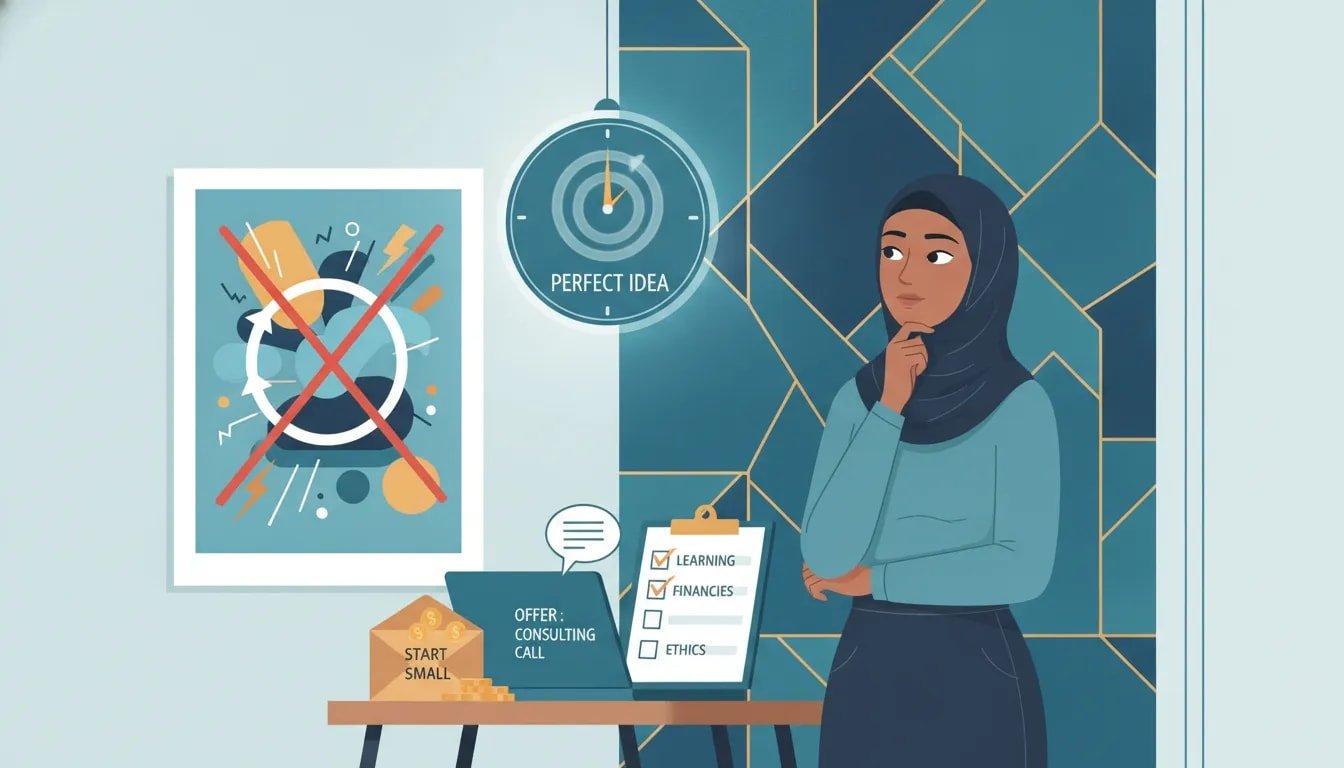
Waiting for a perfect, competition-free idea
Few worthwhile markets are empty. Look for validated demand and an unmet need instead of searching endlessly for an untouched category.
Trying to look successful before becoming useful
Rented luxury items, inflated claims, and image-led marketing may attract attention, but they do not replace competence, trust, or customer value.
Starting without learning the basics
You can begin small while learning, but avoid making large commitments before understanding the industry, customer, costs, and ethical boundaries.
Assuming a lack of money makes progress impossible
A limited budget may rule out some options, but it does not prevent learning, building skills, approaching mentors, gaining work experience, or starting with a simple service.
Relying entirely on a course, mentor, or business model
Education and guidance can be valuable, but they are tools. They do not replace effort, judgement, personal responsibility, or reliance on Allah.
A practical starting plan for aspiring Muslim entrepreneurs
If you are unsure where to begin, focus on progress rather than a grand launch.
-
List your current skills. Include work experience, language ability, technical skills, sales ability, design, writing, organisation, and personal interests.
-
Identify problems you understand. Start with people, industries, or communities you can realistically reach.
-
Speak to potential customers. Ask what they struggle with, how they solve it now, and what they dislike about current options.
-
Choose a simple first offer. A service is often easier to test than a complex product because it can require less upfront investment.
-
Set one weekly action target. Make it specific enough that you can complete or miss it.
-
Find accountability. Ask a trusted person to review your progress weekly.
-
Review the halal boundaries early. Do not leave questions about finance, marketing, contracts, or delivery methods until after the business has grown.
Starting small is not thinking small. It is a way to learn cheaply, build confidence through action, and improve using real feedback.
|
Final thoughts
Muslim entrepreneurship is not about chasing money at any cost. It is about becoming capable enough to provide, give, create value, and maintain independence without abandoning deen.
The consistent themes are clear: gain knowledge, work hard, build trust, refuse shortcuts that compromise your values, seek accountability, and keep taking responsible steps. Wealth may be a test, but lack of wealth can also be a test. The aim is to handle either condition with gratitude, integrity, and purpose.
Frequently Asked Questions About Building Halal Wealth
Can a Muslim become wealthy and still be pious?
Yes. Wealth is not inherently opposed to piety. The key is earning lawfully, avoiding arrogance and distraction, meeting obligations, and using financial capacity responsibly.
Should I avoid a business market because it is saturated?
Not necessarily. Competition can validate demand. Look for a clearer niche, stronger quality, better service, or a specific customer problem that current businesses are not addressing well.
How can I start a business if I have no money?
Start by gaining knowledge, building a valuable skill, working in a relevant field, and testing a simple service. You can also seek advice from experienced people and use accountability to maintain progress.
What should I do if I am scared to start a business?
Reduce the size of the first step. Research one problem, contact one potential customer, learn one skill, or ask one experienced person for advice. Responsible action is more useful than waiting for complete confidence.